Can a Fiber Laser Cut Brass and Copper?
Ee. Na zamani fiber Laser cut brass and copper routinely because their 1064 nm wavelength couples into these metals far better than a CO2 laser's 10.6 micron beam, and current sources ship with back-reflection protection. Plan on roughly 1 kW of power per 1 mm of copper, high-pressure oxygen for copper, nitrogen for brass, and 2 kW and up for reliable production work.
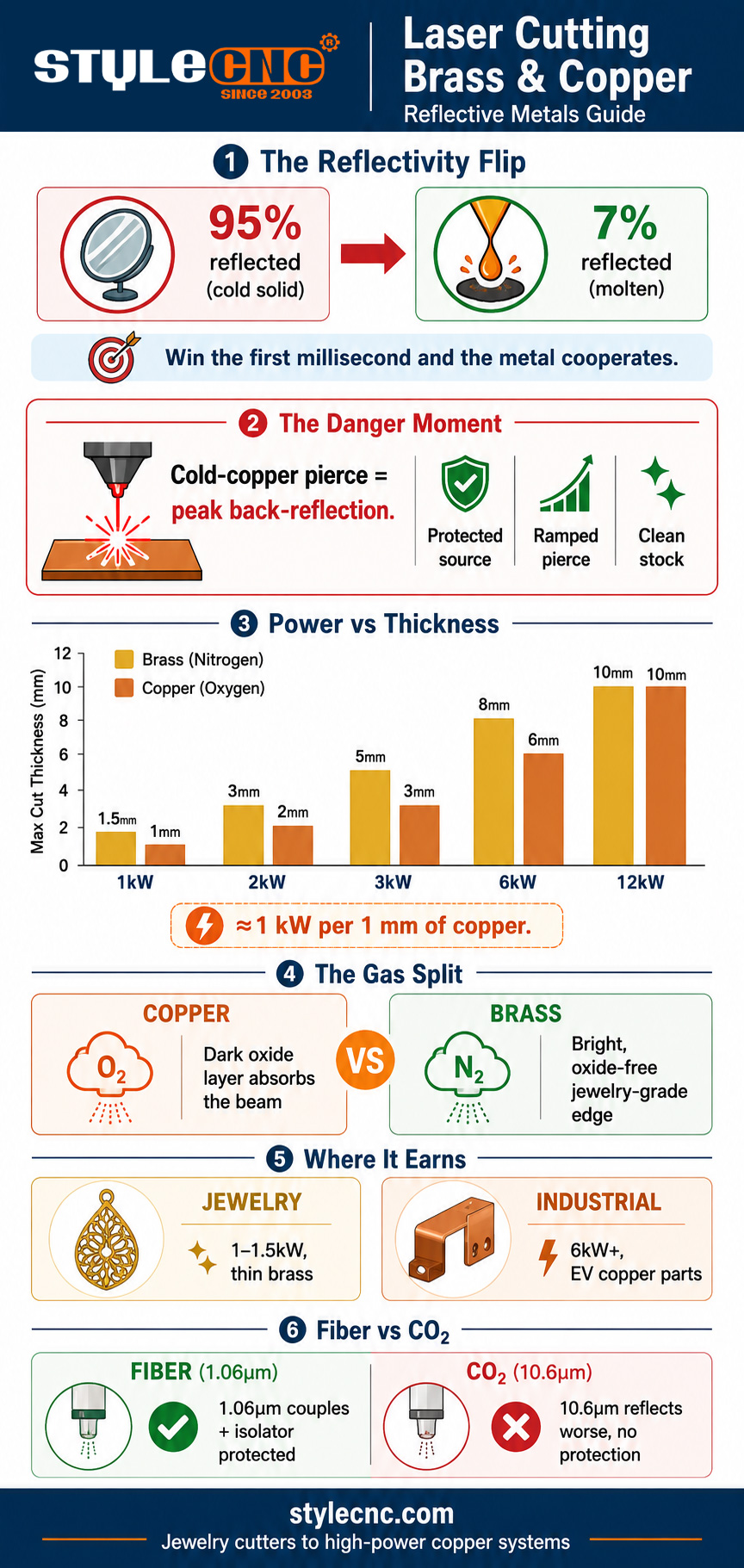
The physics that makes it possible is a temperature trick. Copper's reflectivity is about 95 percent when cold and solid, but it collapses to roughly 7 percent once the metal melts. A fiber laser wins by brute-forcing that transition: maximum power density on a small spot melts the surface in milliseconds, and from that instant the metal absorbs the beam almost completely and cutting proceeds normally. The entire challenge of reflective metals is compressed into the moment before the melt pool exists.
Back-Reflection: Where the Real Risk Lives
That pre-melt moment is the pierce, and it is the highest-risk event in the whole cutting sequence. A full-power continuous pierce into cold, mirror-bright copper sends the maximum possible reflected energy straight back up the beam path in the 1st fraction of a second. On older, unprotected sources, that return light could damage the delivery fiber or the laser module itself, which is where the folklore about lasers and copper comes from.
3 things retired that folklore. Modern fiber sources ship with back-reflection isolation and sensors that fault the laser before damage, often backed by reflection-monitoring shutdown logic. Piercing routines changed: ramped or pulsed pierces keep the mirror phase to milliseconds instead of dwelling at full power on cold metal. And surface preparation became standard, because oil, oxide films, and moisture all raise reflection.
The buying implication is simple: for brass and copper work, confirm in writing that the source, cutting head, and protection systems are rated for reflective metals at your thickness. Parts can look fine while an unrated machine quietly absorbs damaging return light.
Why Fiber Beats CO2 on Reflective Metals
The wavelength gap decides this one before any other spec matters. Copper and brass reflect the CO2 laser's 10.6 micron beam even more strongly than the fiber laser's 1.06 micron beam, so a CO2 machine starts the fight with several times less energy coupling and a worse back-reflection problem, with no protective isolator technology to compensate. CO2 systems keep their place in non-metals and some thick-plate niches, but for brass and copper the industry verdict is settled: fiber or nothing.
The same wavelength advantage is the foundation of the whole fiber category, covered in depth in the Jagorar fasahar fiber laser. For reflective metals it converts directly into lower minimum power, faster piercing, and a safer optical path.
Minimum Power and Thickness Limits
The working rule of thumb for copper is roughly 1,000 W of power per millimeter of thickness, with brass slightly more forgiving because its zinc content absorbs better. The table below translates that into practical windows.
| Ƙarfin Laser | Brass (Production) | Copper (Production) | Aiki Na Musamman |
|---|---|---|---|
| 1 kW | Har zuwa 1.5 mm | Har zuwa 1 mm | Jewelry, tags, thin sheet |
| 2 kW | 2 zuwa 3 mm | 1.5 zuwa 2 mm | Signage, decorative panels |
| 3 kW | 4 zuwa 5 mm | 3 mm | Gabaɗaya ƙirƙira |
| 6 kW | 6 zuwa 8 mm | 5 zuwa 6 mm | Busbars, electrical parts |
| 12 kW+ | 10 mm + | 8 to 10 mm+ | Production copper/brass plate |
2 parameter habits keep cuts inside the safe window. Run the highest peak power the source allows, because power density is what shortens the reflective phase, then back the feed rate off 10 to 15 percent from the maximum that severs, buying process margin. And keep focus at or very near the material surface for both pierce and cut; reflective metals punish defocus faster than steels do.
The Gas Strategy That Splits Brass from Copper
Here is the counterintuitive part: the 2 metals want different gases, and the copper answer breaks the usual clean-cutting rule.
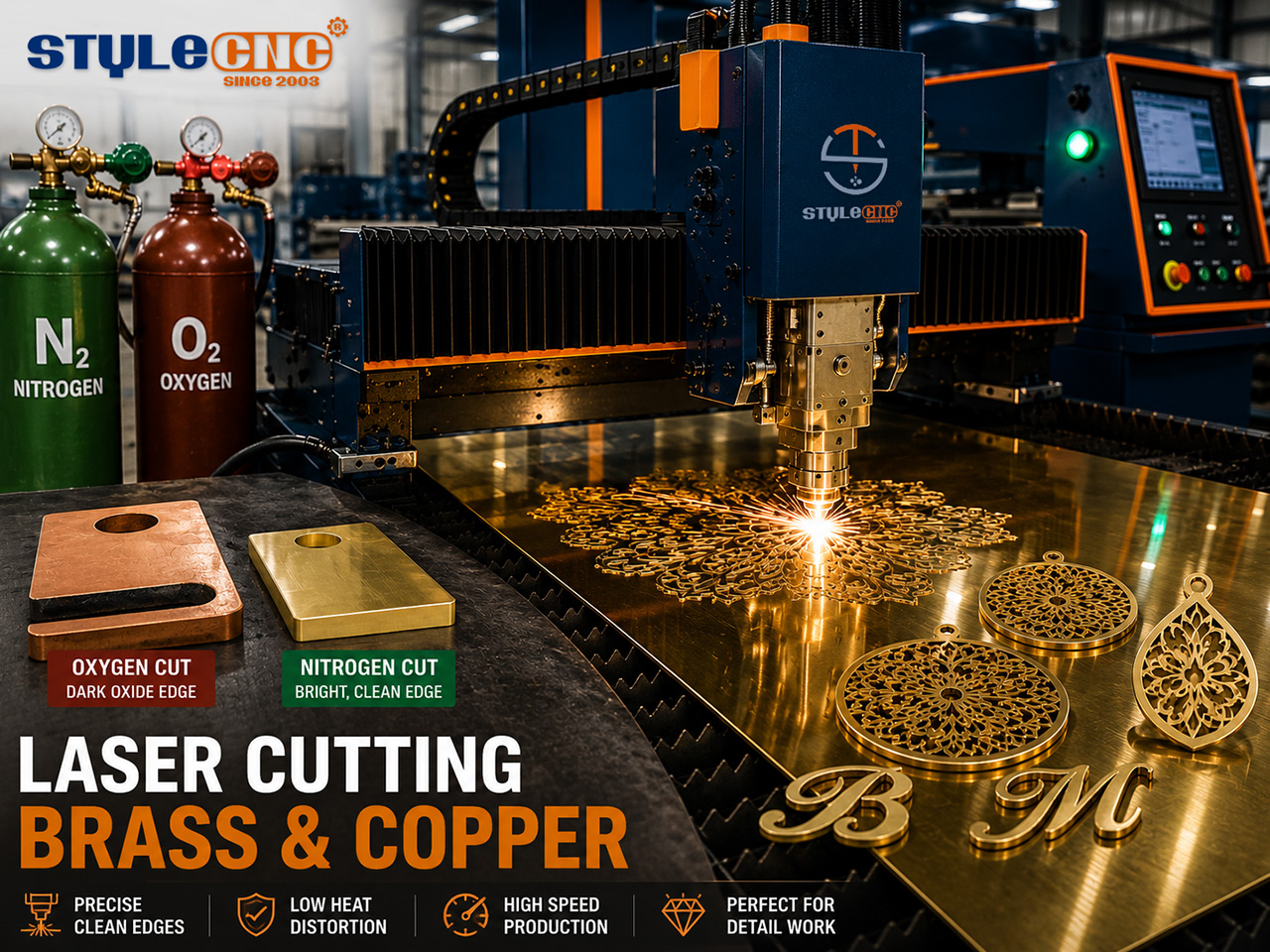
✓ Copper: high-pressure oxygen. Oxygen reacts with the copper surface to form a dark oxide layer, and that darkness is the point: copper oxide absorbs the beam far better than bright copper reflects it. From about 2 mm up, nitrogen-only copper cutting stalls and oxygen becomes mandatory for a reliable pierce and cut.
✓ Brass: nitrogen. Brass behaves closer to a conventional metal thanks to its zinc content, so nitrogen delivers what it always delivers: an oxide-free, bright, clean edge that suits decorative and jewelry work straight off the table. Alloy composition shifts behavior, so parameter-test each new brass grade.
✓ Both: clean stock first. Oil, oxidation films, coatings, and moisture all raise surface reflection. Wiping stock down before cutting is the cheapest back-reflection protection available.
Where Brass and Copper Cutting Earns Money
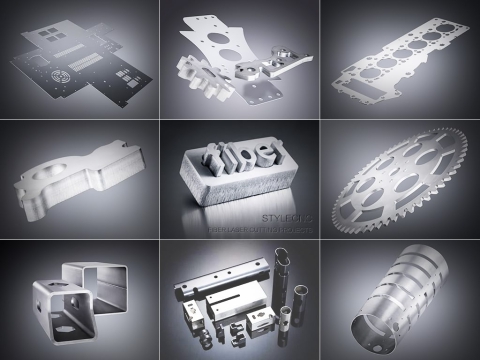
Jewelry and small decorative work is the natural entry point: brass sheet under 1.5 mm cuts cleanly on compact 1 to 1.5 kW machines, and the Injin Yanke Kayan Ado na Laser is configured exactly for that class of work, with the fine-feature accuracy that pendants, earring blanks, and filigree pieces demand. Signage is the 2nd natural fit: brass letters, logo plates, and architectural trim trade on the bright nitrogen-cut edge that needs no rework before polishing or patina.
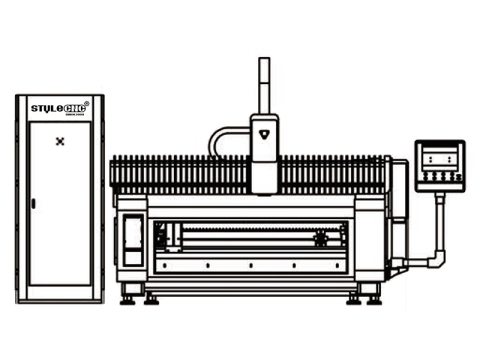
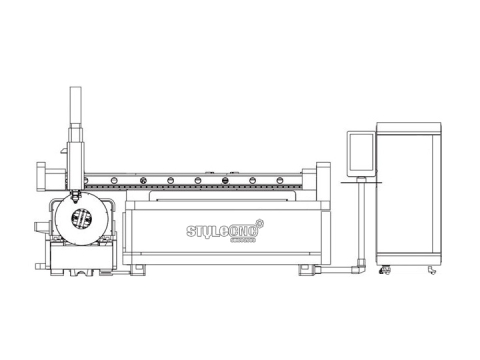
At the industrial end, copper busbars, transformer parts, and electrical connectors are volume laser work, and EV battery production has multiplied the demand. That is 6 kW-and-up territory, where the babban injin yanke ƙarfe na fiber laser class carries the power density and gas delivery that production copper requires. For proof at the mid-range, STYLECNC's 2000 W fiber laser cutting copper demonstration shows the process running on real material.
Tambayoyin da
Will cutting copper damage my fiber laser?
Not on a modern, properly configured machine. The risk window is the pierce into cold copper, when reflectivity sits near 95 percent and return light peaks. Current sources ship with back-reflection isolation and monitoring that fault safely, and ramped piercing keeps the mirror phase to milliseconds. The caveat: get written confirmation that your source and head are rated for copper at your thickness.
Why is oxygen used for copper but nitrogen for brass?
Because copper's problem is reflection and oxygen solves it chemically: the oxide layer it forms is dark and absorbs the beam dramatically better than bright copper. Below about 1 mm, nitrogen can manage; from roughly 2 mm, oxygen becomes necessary. Brass, helped by its zinc content, absorbs well enough that nitrogen's usual benefit wins instead: a bright, oxide-free edge ready for polishing, which is exactly what decorative and jewelry work needs.
How much power do I need to cut brass sheet?
For jewelry and thin decorative brass up to about 1.5 mm, 1 kW is enough and cuts cleanly. Signage-gauge brass at 2 to 3 mm wants 2 kW. General fabrication at 4 to 5 mm sits in 3 kW territory, and thick brass plate moves into 6 kW and beyond. Brass runs slightly thicker than copper at every power level because it absorbs the fiber wavelength better.
Za a iya CO2 laser cut brass or copper?
Effectively no, and it should not be attempted on machines without reflective-metal protection. Both metals reflect the 10.6 micron CO2 wavelength even more strongly than the fiber wavelength, so coupling is worse and back-reflection risk higher, with no isolator technology in the optical path. This is a of the clearest cases in metal cutting where the fiber laser is not just better but categorically the right tool.
Why do my brass cuts vary between material batches?
Brass is a family of copper-zinc alloys, not one material, and the zinc fraction that helps absorption varies by grade. Higher-zinc alloys cut more easily; leaded free-machining grades behave differently again. Surface condition adds a 2nd variable, since oxidation and films change reflection. The working fix is the same as for aluminum alloys: keep parameters per grade and run a short test cut when a new batch lands.
Kwayar
Brass and copper stopped being forbidden metals the day fiber sources got back-reflection protection and operators learned to respect the pierce. The recipe is consistent: maximum power density to blow through the reflective phase, focus tight to the surface, oxygen for copper and nitrogen for brass, clean stock, and roughly a kilowatt per millimeter of copper as the sizing rule.
STYLECNC configures fiber lasers across that whole range, from the jewelry-class metal Cutting Machine for thin brass work to tsarin iko mai girma for production copper. Send the STYLECNC team your metals, thicknesses, and volumes for a reflective-metal-rated configuration and gas recommendation.